empirica Forecasts: New Data on Demand for New Buildings


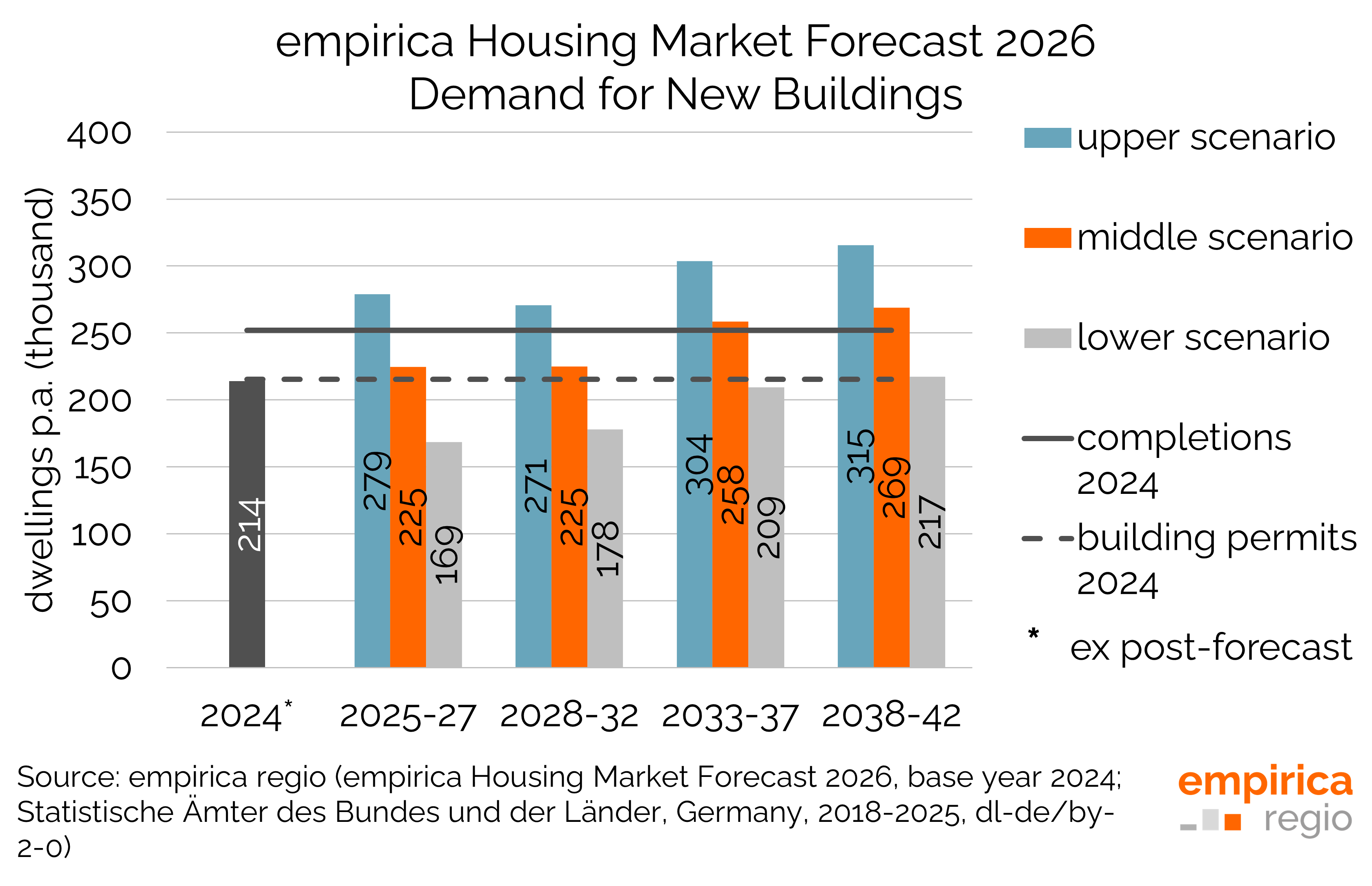
According to the new empirica population forecast, the number of inhabitants will change from around 83.6 million in 2024 to 80.3 million in the lower variant and 86.3 million in the upper variant in 2045. The empirica demand forecast shows an annual demand for new construction of around 225,000 apartments for the period 2025-32. From the mid-2030s, demand will rise to around 260,000 units per year.
empirica regio has updated the harmonised empirica population forecast and the housing market forecast. The new forecast begins with the base year 2024 and covers the period from 2025 to 2045. The data is based on adjusted population statistics from the 2022 census. The empirica population forecast forms the basis for the regional empirica forecasts of household numbers, demand for new construction and vacancy rates.
Looking to the future: Where Germany will grow by 2045 – and where it will shrink
How will the population in our cities and municipalities develop by 2045? A new population forecast now provides detailed answers to this question. Based on the 15th coordinated population projection by the Federal Statistical Office (Destatis), three scenarios are presented that show the range of possible developments. The forecast is based on a lower, middle and upper variant. A key factor here is immigration: while empirica regio assumes high figures at the beginning of the forecast period, immigration will decline continuously in the following years and is expected to stabilise at a constant level from 2033 onwards.
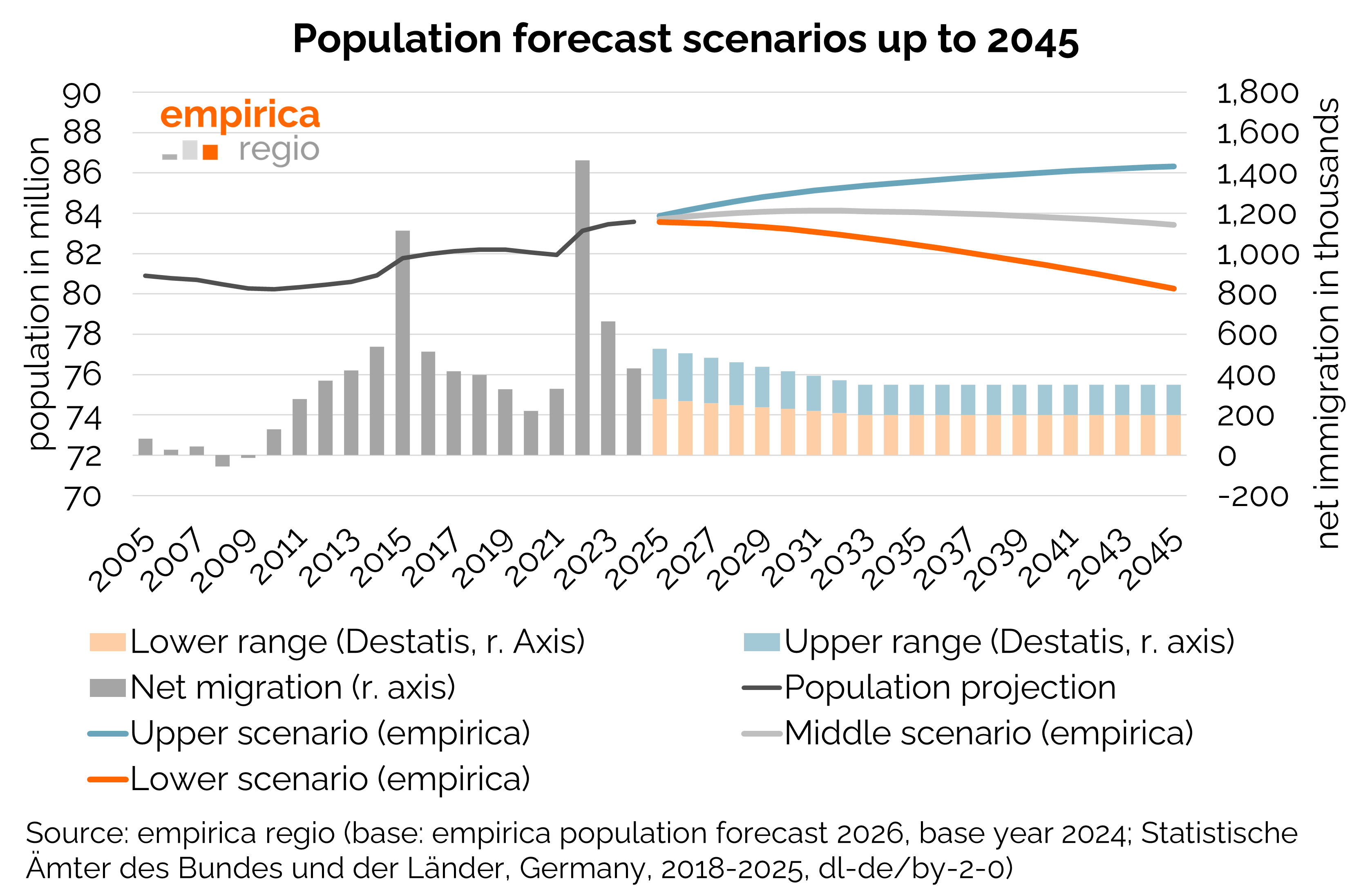
In the future, there is likely to be further cyclical immigration as a result of refugee movements, but at the same time it is imperative to address the decline in immigration, as shown in the lower variant of the forecast. This is particularly important given that all three scenarios predict an increase in the number of deaths due to ageing, while the number of births will decline due to a smaller number of young people.
Despite an overall stable development in the upper variant, the analysis shows a clear regional imbalance. As migration movements – both from abroad and within Germany – are heavily concentrated in certain centres, the existing north-south and east-west divide will continue to widen. Particularly critical: many regions must prepare for a long-term decline in population. While this will only occur later in the optimistic scenario, in the lower variant many districts and municipalities could be confronted with declining population figures in the short term.
Why demand for new buildings is rising despite declining population figures
An apparent contradiction will characterise the coming years: although the population could decline in the long term, demand for new housing will increase again from the 2030s onwards. For the period from 2025 to 2027, the medium scenario anticipates an annual demand of around 225,000 new homes. In the 2030s, this figure will climb to over 250,000 units per year. Depending on the intensity of immigration, these figures fluctuate by around 50,000 residential units up or down in the various scenarios.
The current analysis shows that the housing market is facing complex structural change. The reasons for this are growing additional demand for quality (e.g. lack of modern amenities), but also regional differences in population and household development and changes in the demographic structure, in particular the increase in the number of older people. In some regions that have recently experienced demographic growth, demand is also rising due to the echo effect of the children of earlier migrants forming households.
In future, there are likely to be further cyclical peaks in immigration as a result of refugee movements. These will then have an impact on housing demand. However, it must be borne in mind that it is not possible to build housing in advance for immigration peaks such as those seen in 2015 or 2022. In addition, such peaks are always followed by a return migration in subsequent years. For this reason, classic housing is not required for all households that come to Germany in the wake of cyclical migration peaks.
Backlog: Why calculations often fail to reflect reality
The number of homes that would have been needed but were not built is sometimes referred to as the backlog. But how big is this gap really? The latest analysis by empirica regio urges caution when it comes to overly simplistic calculations. To determine a realistic backlog, it is not enough to simply subtract old forecasts from construction statistics. The following factors must be taken into account:
- The statistics must be adjusted retrospectively to reflect actual population trends and age structure (ex-post analysis).
- The backlog is limited to the additional quantitative demand.
- Deficits from many years ago cannot be added up indefinitely.
- Rising rents and prices are dampening demand. A calculated demand only leads to new buildings if there is a real willingness to pay on the market.
Interestingly, the balance sheet for 2024 shows a positive turnaround. For the first time in a long time, supply exceeded demand for new builds alone. Most recently, 216,000 more new flats were built in residential buildings, as demand for new construction was only 214,000 flats. Including conversions of existing buildings and new construction in non-residential buildings, the number of completions in 2024 was as high as 252,000 flats.
Anyone interested in the detailed background, methodological criticism of the backlog and long-term forecasts will find a comprehensive evaluation in the current empirica paper No. 281. The document offers a critical assessment of the figures and shows which orders of magnitude are truly realistic.
Data sources and methodology
The empirica population forecast for 2026, with 2024 as the base year, forms the basis for all forecasts. On this basis, empirica has produced a forecast for households, also with 2024 as the base year. After deducting sublet households and adding the demand for second homes, the result is the number of households demanding housing. The increasing number of households demanding housing reflects the additional demand for housing caused by changes in population size, household size and the age distribution of households. In general, the more inhabitants there are, the greater the demand for housing. Larger households tend to demand single-family homes, while older households, which are usually smaller, tend to demand multi-storey flats.
Detailed results and further information on the methodology can be found in a current publication, which is available for download on the website of empirica ag (in German only):
External download (available in German only): empirica-Paper Nr. 281