Housing Vacancy 2024: Second Largest Decline in 20 Years


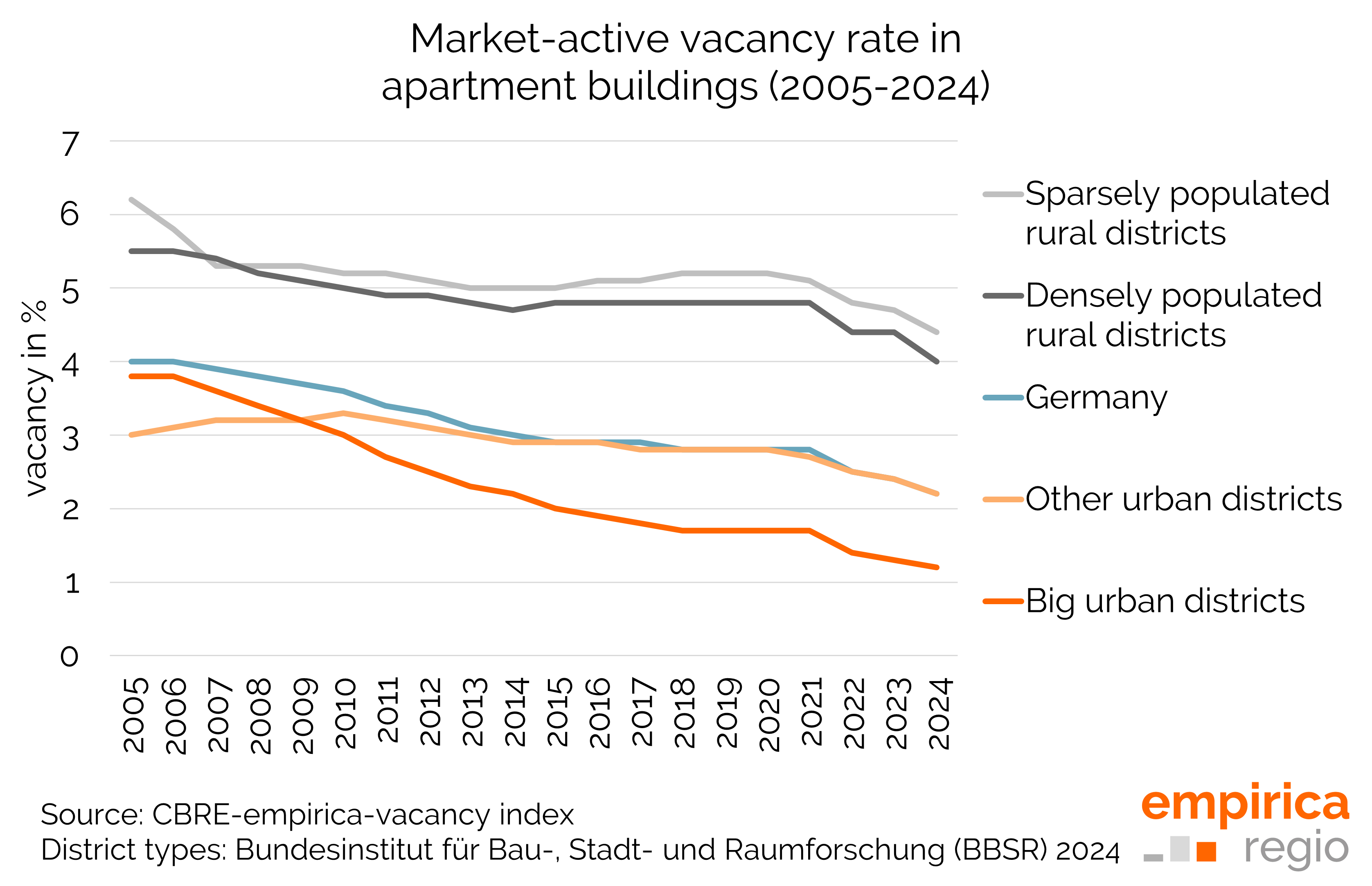
The current vacancy index shows a significant tightening of the German housing market. In 2024, the number of market-active vacant apartments in multi-family housing decreased by approximately 45,000 to 522,000 units. The nationwide vacancy rate is now only 2.2 percent. This represents the second-largest decline in the 24-year history of the survey. Vacancy rates are falling in 85 percent of all districts and independent cities.
The development of vacancy rates in 2024 was marked by a slump in new housing construction (a good 42 thousand fewer apartments than in 2023) combined with continuously high net immigration from abroad (around 430 thousand people). The gradual normalization of the housing market, which was still noticeable until the end of 2021, was abruptly halted on the supply side.
In major cities (big urban districts), the vacancy rate is now only 1.2 percent (1.3 percent in the previous year). Other urban districts also show only minor vacancy reserves (2.2 percent, compared to 2.4 percent in the previous year). Even in rural areas, vacancy rates are falling, to 4 percent in densely populated regions and to 4.4 percent in sparsely populated districts (compared to 4.4 and 4.7 percent in the previous year, respectively).
In shrinking regions, the vacancy rate is stagnating at 6.9 percent. In contrast, the vacancy rate in growth regions is only a below-average 1.4 percent, moving further away from a balanced housing market than ever before.
Full occupancy in metropolitan areas: The market is practically swept clean in the most desirable cities. Freiburg, Munich, and Frankfurt am Main have extremely low vacancy rates of 0.1 percent each. Even in Münster and Darmstadt (0.2 percent each), there is hardly any free living space available. At the other end of the scale are cities like Dessau-Roßlau (7.6 percent) and Pirmasens (7.3 percent).
The look at the change over the last five years is interesting. Cities such as Schwerin, Leipzig, and Frankfurt (Oder) show massive decreases in vacancy rates (up to 2.5 percentage points less since 2019). Even in the structurally weak Pirmasens, the oversupply is shrinking. In the 5-year comparison, noteworthy increases in vacancy were almost exclusively observed in Suhl.
Further Information
The CBRE-empirica-Vacancy Index is the only data source providing figures on market-active vacancies in multi-family housing in Germany. The current figures are based on management data from the real estate consulting firm CBRE (approx. 864,000 residential units as of December 31, 2024) as well as extensive analyses and estimates based on the empirica regional database and the Federal Statistical Office. The resulting vacancy rates are extrapolated to the total stock of all multi-family housing units in residential buildings.
Detailed results and further information on the methodology can be downloaded from the empirica ag website.