Housing Price Index Q2/2026: "Frantic Standstill" on the Price Front


“There is currently a frantic standstill at the price front of the housing market,” says Dr Reiner Braun in his latest commentary on the Q2/2026 data of the empirica housing price index. Purchase prices show little movement nationwide, while only rents continue their steady rise.
Current figures on the Housing Price Index Q2/2026
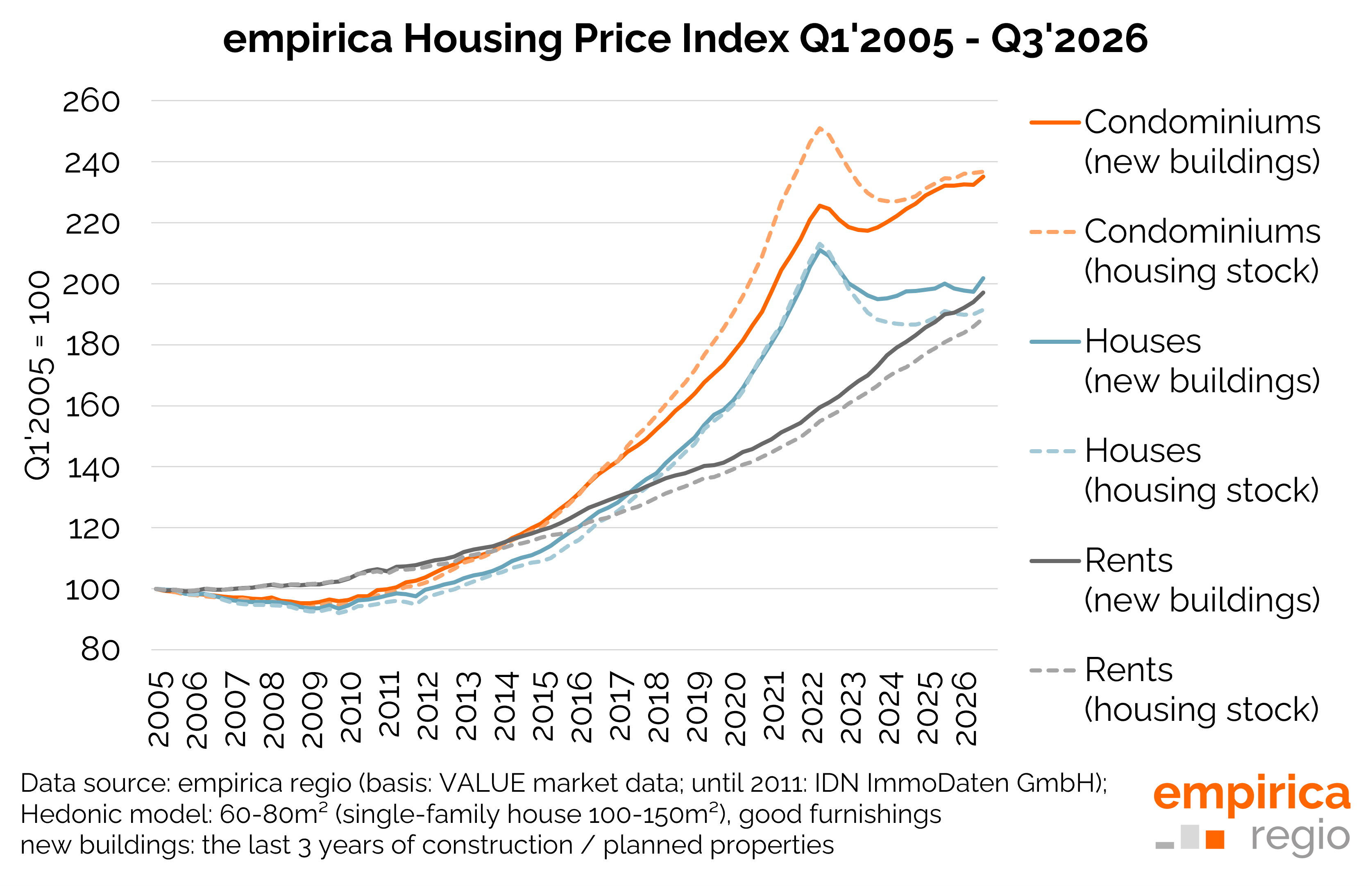
In the new-build segment, prices for owner-occupied flats and single-/two-family homes fall slightly, while rents rise by 0.9%. Compared with the same quarter of the previous year (Q2/2025), single-/two-family homes remain slightly down (-0.5%), the index for owner-occupied flats rises slightly (+0.8%), and the rent index rises more strongly (+3.4%).
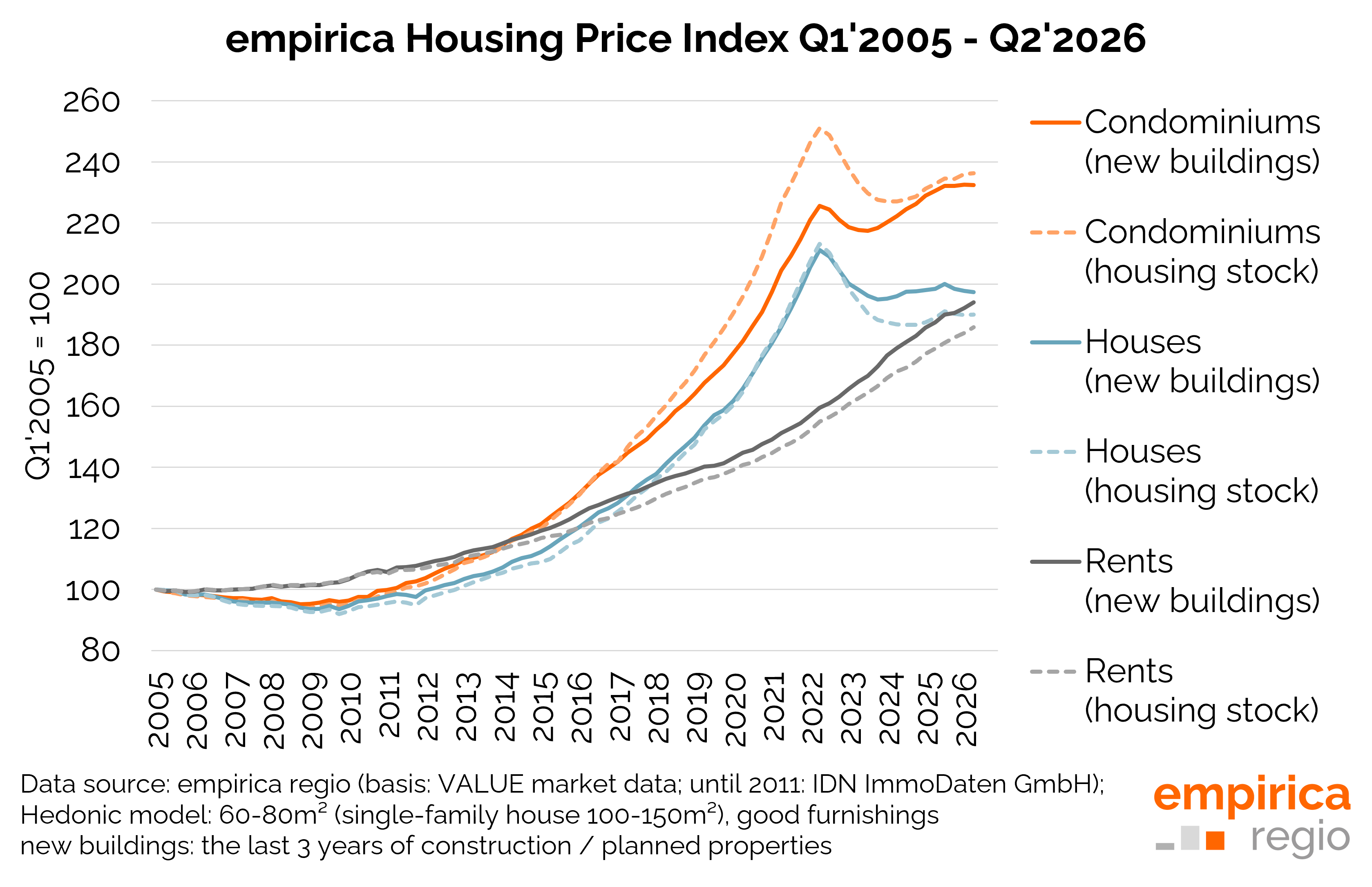
For existing properties, the indices for single-/two-family homes (EZFH) and owner-occupied flats (ETW) are nearly stagnant. Both show a change of +0.1% in Q2/2026 compared with the previous quarter. Compared with the same quarter of the previous year (Q2/2025), ETW shows a larger increase of 1.5%, while EZFH records only a 0.6% rise. The price level from the beginning of 2022 remains within reach, especially for ETW, though the catch-up process will still take time.
The index for existing rental flats continues to rise steadily, up 1.0% on the previous quarter. The 3.9% increase compared with Q2/2025 shows, in contrast to ETW and EZFH, an unbroken and constant trend with no sign of a turnaround.
Data basis Housing Price Index
All empirica housing price index data can be obtained as individual data sets or via database access from empirica regio. Further figures can be found in the quarterly publication on the index.

The current commentary by Reiner Braun: Real estate number acrobatics
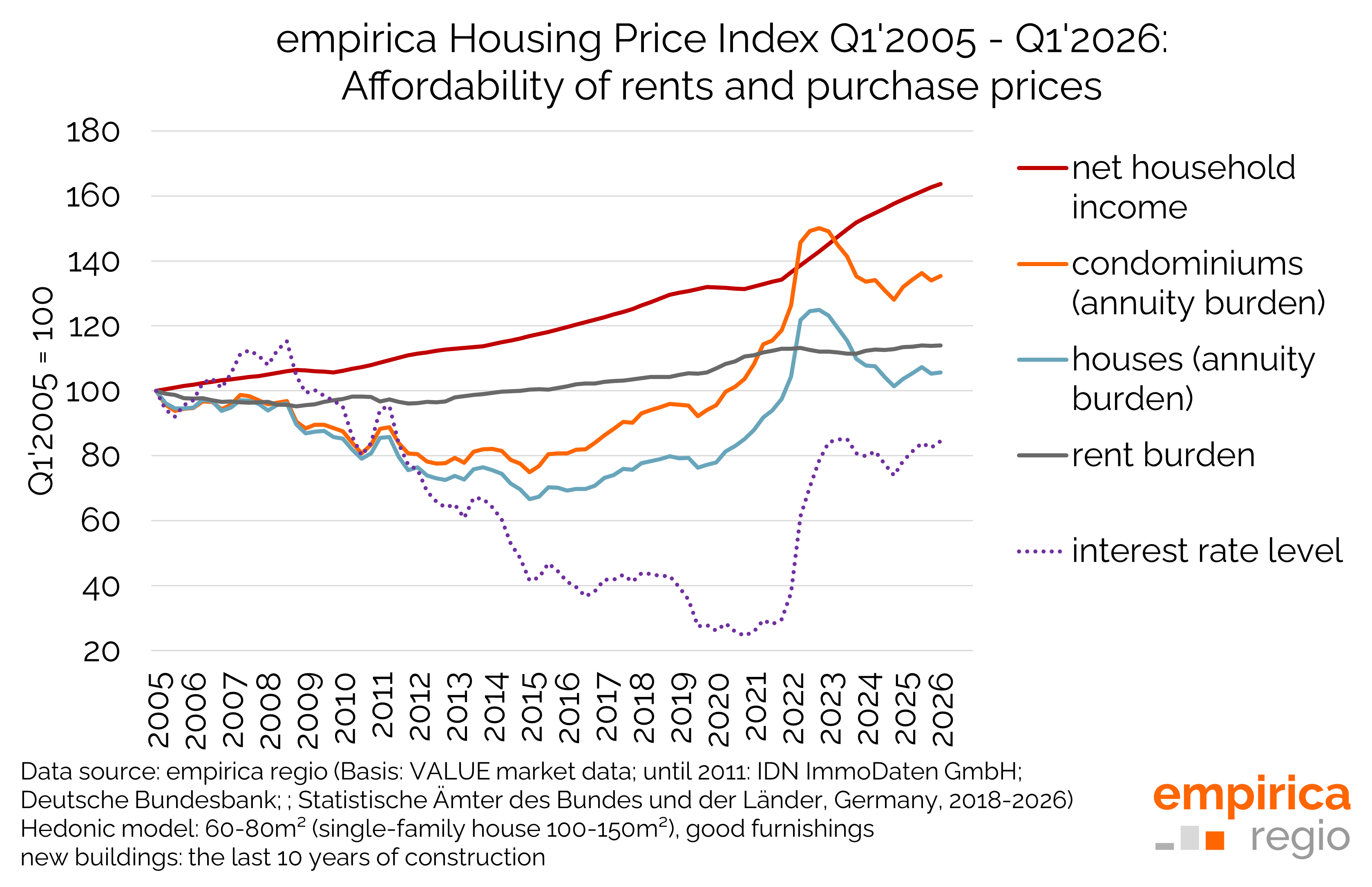
There is currently a frantic standstill at the price front of the housing market. Two opposing forces are responsible for this: on the one hand, interest rates – which have risen back towards four percent since the start of the year – are making financing harder and pushing prices down. On the other hand, the ongoing new-build crisis is squeezing supply and pushing prices up. The result is an undecided zero-sum game. Nevertheless, analysts eagerly interpret every minimal fluctuation as a turning point – depending on their own point of view.
Two current theses complete the general confusion: the myth of the “silver tsunami” and the legend of “building the wrong thing”. Both can quickly be disproved.
The fear of a “silver tsunami” – a sudden flood of properties caused by the passing of the older generation – ignores biology. The baby boomers are spread across around 15 birth cohorts. Their mortality is stretched over 15 to 20 years each. So instead of a single wave, inheritances trickle onto the market as rather small streams over 35 years. Moreover, prices in rural areas are already low; with so little room to fall, a price tsunami simply cannot happen there.
The claim that we are “building the wrong thing” is also wrong. New-build homes in rural areas are not standing empty. In purely quantitative terms they are often superfluous, but qualitatively they hit the mark. What stands empty there is only the uninhabitable old junk housing. Without this new-build stock, the alternative for the rural population would be to move to the cities as well – to demonstrate for expropriations once they get there.
In the cities themselves – contrary to all the doom-mongering – it is precisely the large flats that are missing. If small flats are easier to market there, that is not down to their size, but to their price. And the urban population bears some responsibility for this through its own voting and protest behaviour: the politicians it elects designate too little building land, citizens themselves block projects through NIMBY protests (“Not In My Backyard”), and an ideologically overloaded building and tenancy law delivers the final blow to urban new-build construction.
So is there a silver tsunami? No. Are we building past demand? No. Are we building too expensively? Yes. Are prices stagnating? Yes.